



How Much Does It Cost to Build a Website in Nigeria? A 2026 Beginner’s Guide
Introduction: Why Everyone is Asking About Website Design Cost in Nigeria
Have you ever walked into a market in Lagos or Abuja and asked, “How much is a bag of rice?” You know the answer usually starts with, “It depends.” Building a website is very similar. If you are a small business owner, a blogger, or a creator, knowing the website design cost in Nigeria is the first step toward moving your ideas from your head into the digital world. You don’t want to overpay, but you also don’t want a “cheap” site that crashes the moment two people visit it.
Think of a website like building a house. You need land (that is your domain name), you need a foundation and roofing (that is your hosting), and you need an architect and builder (that is your web designer). In Nigeria today, the price of these things changes based on what you want. Do you want a simple face-me-I-face-you apartment, or are you looking to build a multi-story mansion with a swimming pool? Both are houses, but the costs are worlds apart.
In this article, we are going to break down every single kobo you might spend. We will talk about the hidden fees, the “big boy” corporate prices, and the “manage-it-like-that” DIY options. By the time you finish reading this, you will have a clear budget in mind and won’t be confused when a developer sends you a quotation that looks like a phone number.

1. The Starting Line: Domain Names and Hosting Fees
Before you even talk to a designer, you need a name. In the tech world, we call this a Domain Name. This is your address on the internet, like www.yourbusiness.com. The website design cost in Nigeria always starts here. If you want a .com address, you might pay between ₦12,000 and ₦20,000 per year. However, if you want to show your “Naija pride” with a .ng or .com.ng extension, the prices vary. A .com.ng is usually the cheapest, often under ₦5,000, while a main .ng can be quite expensive, sometimes reaching ₦15,000 to ₦25,000.
After the name, you need “Hosting.” Imagine hosting as the rent you pay for the space your website occupies on the internet. If you don’t pay for hosting, nobody can see your site. For beginners, “Shared Hosting” is the best way to start. It is like living in a flat with roommates; it’s cheap because you share the resources of the server. Local Nigerian hosting companies might charge you anywhere from ₦15,000 to ₦60,000 a year. International hosting is often paid in dollars, which can be tricky with the current exchange rate, but it often offers better speed for global audiences.
The mistake many beginners make is forgetting that these are recurring costs. You don’t just buy a domain and hosting once and forget it; it is like your DSTV subscription. If you don’t renew it every year, your website will disappear. So, when calculating your cost of building a website in Nigeria, always remember to put aside some money for your yearly “internet rent.” It is better to start small with a reliable local host than to go for a big US-based host that you can’t afford when the Dollar-to-Naira rate jumps again.
2. Choosing Your Path: DIY vs. Hiring a Professional
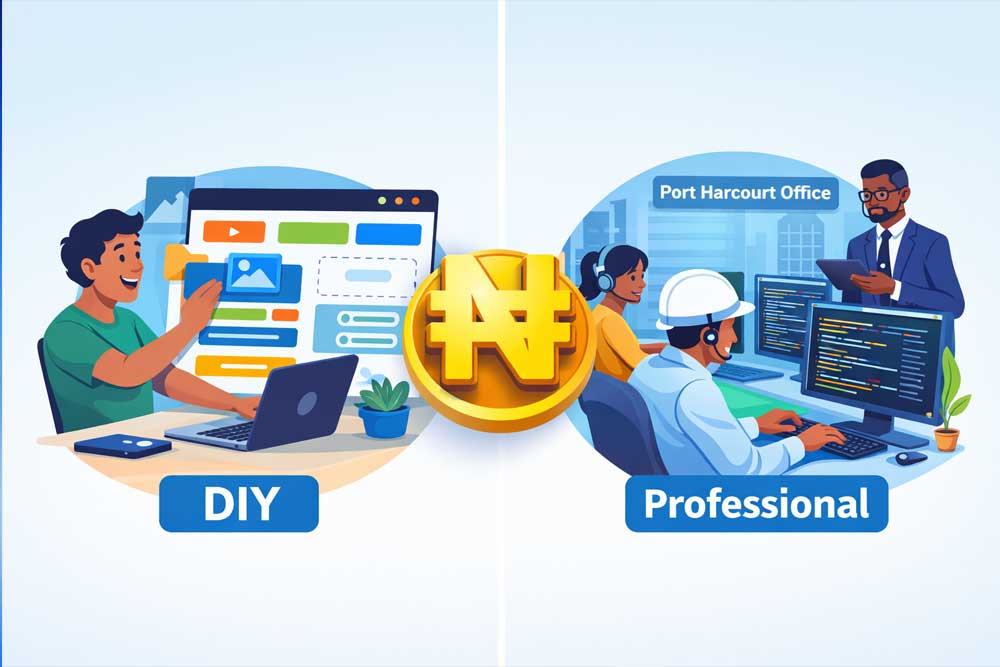
This is where the real money talk happens. You have two main choices: do it yourself (DIY) or hire a professional. If you choose the DIY route using tools like WordPress or Wix, your website design cost in Nigeria will be very low. You might only spend money on your domain, hosting, and maybe a premium “template” (a pre-made design). This could cost you a total of ₦50,000 to ₦100,000. It’s like cooking your own Jollof rice at home—it takes time and effort, but it saves you a lot of money.
On the other hand, hiring a freelance web designer is like ordering a full tray of party Jollof from a professional caterer. You pay for their skill, their tools, and the fact that you don’t have to stress. However, you must be careful not to fall into the trap of “cheap” services that don’t deliver. To help you choose the right person, check out these 5 costly mistakes to avoid when choosing affordable web design services. A junior freelance designer in Nigeria might charge between ₦80,000 and ₦200,000 for a basic five-page website.
If you go to a big digital agency in Ikeja or Victoria Island, be ready to hear prices starting from ₦500,000 to ₦5,000,000 or more. If you are looking for a list of experts to work with, you can explore this guide on top website designers in Nigeria to see who fits your style. An agency isn’t just one person; they have a project manager, a designer, a coder, and a content writer all working on your project. This is for “big brands” who need high security and custom features. For a beginner, a skilled freelancer is usually the “sweet spot” where you get quality work without breaking the bank.
3. Breaking Down the Categories: What Kind of Website Do You Need?
Not all websites are created equal. The website design cost in Nigeria depends heavily on what the site actually does. Let’s look at a “Business Brochure” website first. This is a simple site that tells people who you are, what you do, and how to find you. It’s basically a digital business card. Because it doesn’t have many moving parts, it is the most affordable. You can expect to pay a professional between ₦100,000 and ₦250,000 for this kind of clean, professional setup.
Now, let’s talk about E-commerce—the “Online Store.” If you want to sell products, take payments through Paystack or Flutterwave, and manage inventory, the price goes up. E-commerce sites are like building a physical shop with a cash register and a security guard. You need extra layers of security (SSL certificates) and complex coding to make sure people’s money is safe. For a standard online store in Nigeria, budgets usually start from ₦250,000 and can go up to ₦1,000,000 depending on how many products you have.
Then there are “Custom Portals.” These are sites like school management systems, hospital records, or dating sites. These require “Heavy Lifting” in terms of coding. These aren’t just pages people look at; they are tools people use. Because of the complexity, the cost of building a website in Nigeria for these projects is almost always custom-quoted. You are looking at a minimum of ₦500,000. It’s like the difference between buying a ready-made shirt and getting a tailor to sew a custom Agbada from scratch; the tailor-made one will always cost more because of the labor involved.
4. The Hidden Costs: Content, Images, and Maintenance
Most people only think about the design, but what about the words and pictures? A website without content is like a beautiful car without an engine. If you can’t write your own “About Us” page or take professional photos of your products, you will need to hire a content writer and a photographer. This adds to the website design cost in Nigeria. A professional writer might charge ₦10,000 to ₦30,000 per page to make sure your website sounds persuasive and clever.
Images are also a big deal. You can’t just “steal” photos from Google; that can get you into legal trouble. You either buy “Stock Photos” in dollars or hire a local photographer to take real shots of your office or products. Real shots are always better because they build trust. If a customer sees a photo of a real Nigerian office instead of a generic American one, they are more likely to believe you are a real business. Budgeting an extra ₦30,000 to ₦70,000 for professional media is a very smart move for any serious creator.
Finally, there is maintenance. Websites are like cars; they need oil changes and servicing. Plugins need to be updated, and the site needs to be backed up so you don’t lose everything if something goes wrong. Some designers offer a monthly “Maintenance Fee” of ₦10,000 to ₦30,000. While it seems like an extra expense, it saves you from the “heart attack” of waking up one morning to find your website replaced by a “Hacked by Anonymous” message. Maintenance keeps your website design cost in Nigeria predictable by avoiding expensive emergency repairs later.
5. SEO and Marketing: Getting People to Visit Your Site
Building a website and not doing SEO is like printing 1,000 flyers and keeping them under your bed. Nobody will see them! SEO stands for Search Engine Optimization. It is the art of making sure that when someone types “Best bakery in Enugu” into Google, your website shows up on the first page. Many designers include basic SEO in their website design cost in Nigeria, but advanced SEO is a separate service.
One of the most important parts of SEO today is ensuring your site works perfectly on phones. You can read more about why this is a game-changer in our guide on the importance of mobile-friendly website design in 2025. In Nigeria, internet speed can be slow and most people use smartphones, so a fast-loading, mobile-ready site is a huge advantage. If you want an expert to help you rank on the first page of Google, you might spend an additional ₦50,000 to ₦150,000 per month on marketing.
You should also consider Social Media integration. Your website should talk to your Instagram, Facebook, and WhatsApp. In Nigeria, WhatsApp is the “king” of communication. A good designer will add a “WhatsApp Chat” button to your site for free or a small fee. This allows customers to click one button and start chatting with you immediately. This small feature can double your sales, making the initial cost of building a website in Nigeria feel like the best investment you ever made for your business growth.
Summary: Budgeting for Your Nigerian Website
To wrap it all up, let’s look at the numbers one last time so you can plan. For a Starter/Personal Site, budget ₦60,000 to ₦120,000. This covers your basic domain, hosting, and a simple design. For a Small Business Site, budget ₦150,000 to ₦350,000. This gets you professional pages, better SEO, and a design that looks great on iPhones and Androids. For a Corporate or E-commerce Site, budget ₦400,000 and above to ensure you have the security and features needed to handle money and lots of traffic.
The most important thing to remember is that the website design cost in Nigeria is an investment, not just an expense. A good website works for you 24 hours a day, even while you are sleeping. It tells your story, sells your products, and finds you new fans. Don’t go for the cheapest person just because they are cheap—you might end up paying twice to fix their mistakes. Find a balance between quality and cost, and you will have a digital home you can be proud of.
Trackback: 10 Common Website Design Mistakes | Digital Agency Nigeria